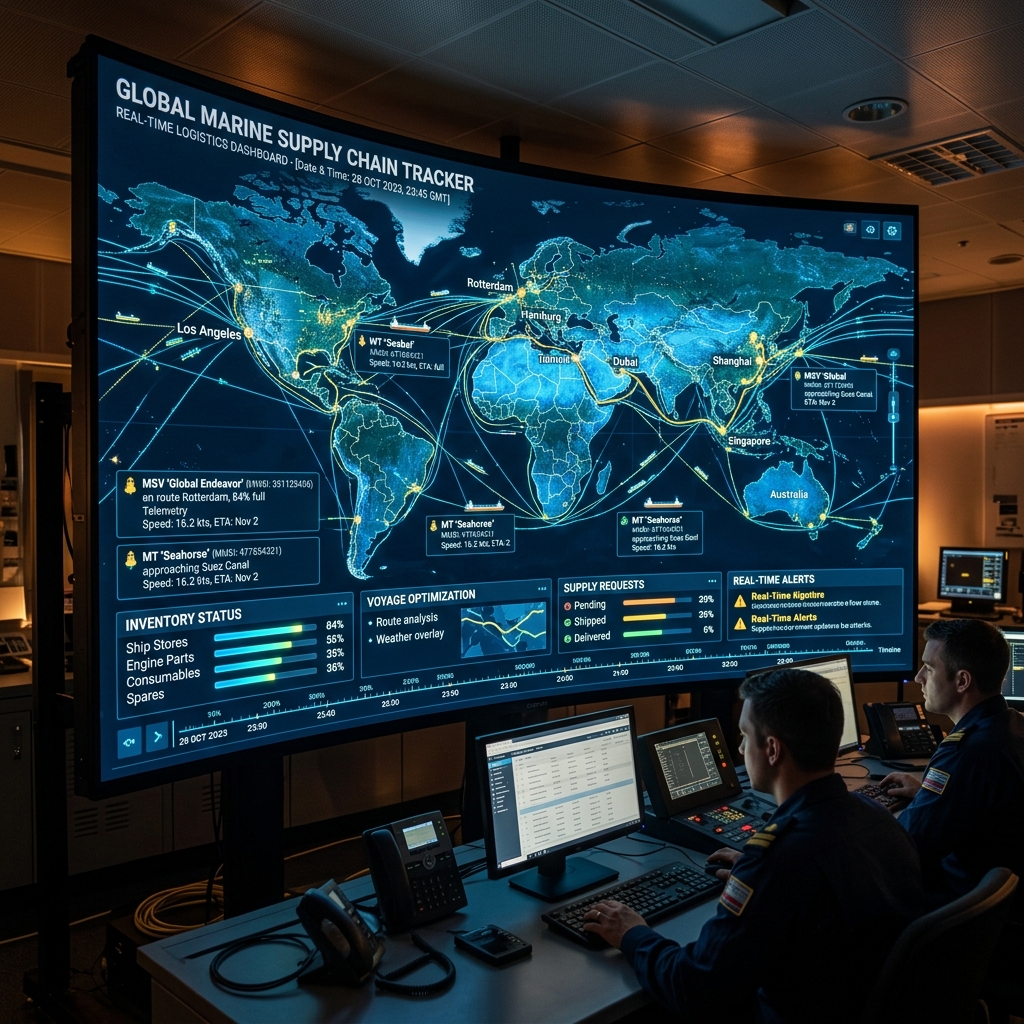
Tracking Marine Supplies in Real-Time

Real-time tracking is a phrase that sounds modern and useful, and most of the time it is. It is also frequently oversold. A GPS dot on a vehicle does not deliver supplies any faster than the vehicle was already going to deliver them. Visibility without operational ability to act on the visibility produces only frustration. The honest case for tracking in marine supply is more specific and more useful than the marketing version - and worth understanding before deciding which tools justify the investment.

Where tracking genuinely helps

The first useful case is replacing the "where is my delivery" call. A vessel agent managing four vessels simultaneously does not have time for status updates by phone every 30 minutes. A web dashboard showing the location and status of each delivery provides the same information at a glance, leaving everyone free to focus on actual decisions.

The second useful case is exception alerting. The vehicle has been stationary for 45 minutes when it should have been moving - alert. The cold chain temperature has drifted out of range - alert. The customs clearance is taking longer than the planning baseline - alert. These are the moments where real-time data converts into real-time action.

The third useful case is post-incident reconstruction. When something does go wrong - a delayed delivery, a temperature excursion, a documentation gap - the time-stamped data trail reconstructs exactly what happened. This converts disputes into resolutions.

Where tracking is mostly cosmetic

Tracking does not make traffic faster. It does not clear customs faster. It does not change physical handling time at the warehouse. For these stages, tracking just shows you the time elapsing - which is informative but not a remedy. Operators looking at tracking expecting it to compress these times end up disappointed.

The right framing: tracking provides information; it does not provide capability. The capability has to exist independently. Tracking that surfaces a delay enables a manual intervention to address the delay; tracking that surfaces a delay you cannot do anything about just generates anxiety.

The categories worth instrumenting

Vehicle-level GPS tracking is now low-cost, broadly available, and standard practice for any chandler operating its own delivery fleet. The marginal investment over the vehicle cost is minimal.

Cold-chain temperature logging is essential for any provisions handler. Continuous temperature data is the basis for both quality assurance and shipping line audit. Sealed loggers that the driver cannot adjust are the standard.

Door-to-door air freight tracking is provided by major carriers and is now expected on any priority shipment. The tracking is more accurate at handoff points than continuously, but the handoff data is what matters most.

Sea freight tracking is less granular - most container ships report position periodically and major events trigger updates. For routine consolidated shipments this level of detail is sufficient.

The dashboard problem

Most tracking systems generate more data than the receiving organisation can process. The result is dashboards that are looked at briefly when a problem is suspected and ignored otherwise. Effective use of tracking depends on alert configuration - the system surfaces only what requires attention rather than overwhelming with continuous status.

The discipline of configuring alerts properly is unglamorous and has high payback. Every alert should be either actionable or informative; alerts that are neither become noise and erode the system's usefulness.

Privacy and security considerations

Real-time tracking generates real-time data about routes, locations, and operational patterns. For chandlers and shipping companies, this data is commercially sensitive. Tracking systems should have appropriate access controls, encryption in transit, and clear policies on data retention and access. The convenience of broad visibility should not become a vulnerability.

From a Chennai operations perspective

For our Chennai operations, the tracking that has produced the most operational benefit is in three places: vehicle GPS for delivery dispatch, sealed temperature loggers for cold-chain handovers, and clearance status visibility for customs paperwork in flight. Together these three streams cover most of where status genuinely changes throughout the supply chain.

What we have deliberately not done is invest in dashboard layers that look impressive but do not affect operating decisions. The right test for any new tracking technology is whether it changes a decision that would have been made differently without it. If yes, it is worth the investment. If not, it is decoration.

For visibility-supported marine supply at Chennai Port, see our ship chandler at Chennai Port operations overview.

← Back to News