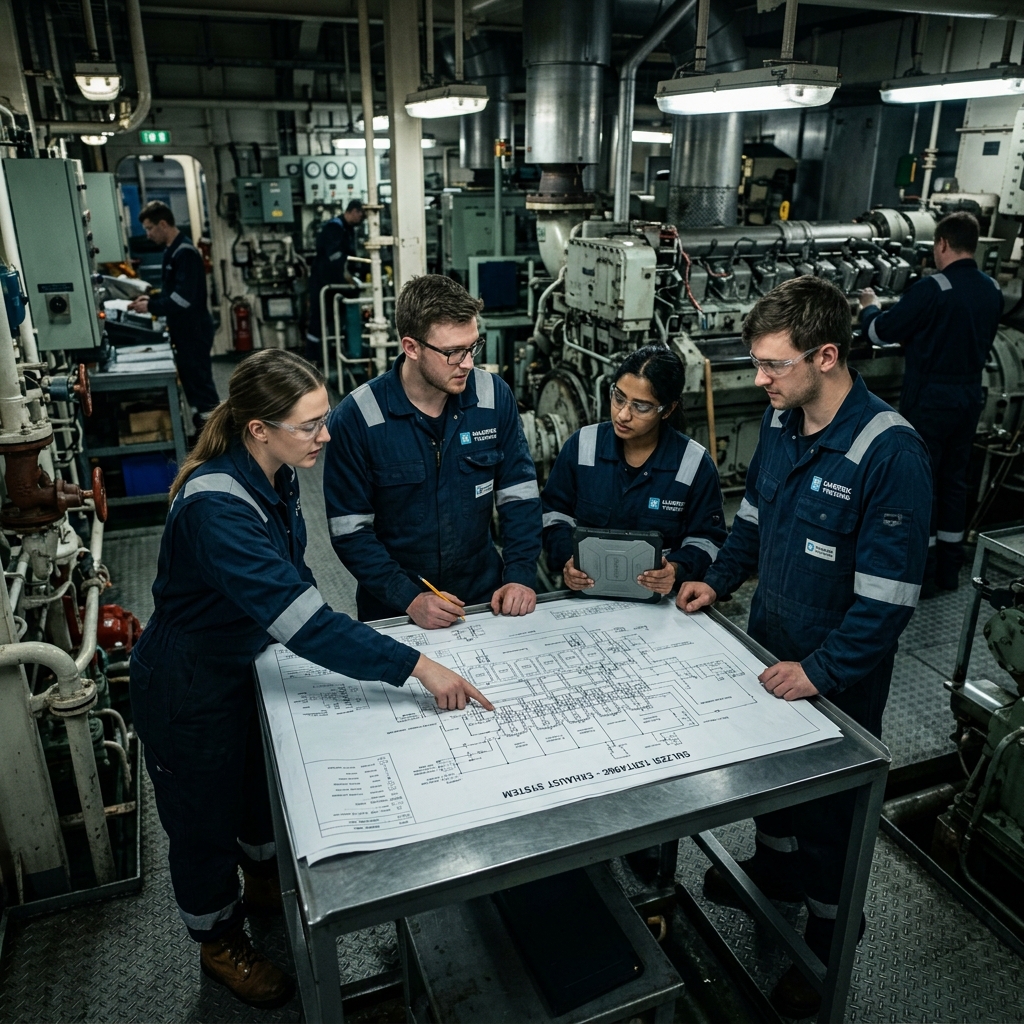
Routine Maintenance for Main Engines

A two-stroke main engine on a bulk carrier is a piece of machinery designed to run for tens of thousands of hours between major overhauls. The reason it actually achieves that life is not the original engineering alone - it is the routine maintenance discipline applied across that life. Skip the discipline and the engine still runs, but the time between expected overhaul and actual overhaul shortens, and the cost curve flips upward.

For vessels supplied at Chennai Port, main engine spares and consumables are one of the most consistent supply streams. Here is what the maintenance routine actually looks like, in the categories that matter for parts ordering and chandler coordination.

Lubrication: the most consistent demand

Main engine cylinder oil, system oil, and turbocharger oil are the highest-volume regular consumables. Cylinder oil is dosed against fuel sulphur content and engine load, with the dosing rate verified against scrape-down analysis from the cylinder. System oil has a longer service life but requires monitoring of oxidation, additive depletion, and contamination through routine lab analysis.

From a chandler's perspective, lubricant supply is high-volume, schedule-driven, and OEM-spec critical. Substitution to a different brand without the engine manufacturer's approval can void warranty and may shift wear patterns. Vessels typically standardise on one or two oil suppliers across their rotation and reorder against the maintenance interval.

Filters and consumables on schedule

Fuel filters, lube oil filters, air filters, separator filters - each has a documented replacement interval based on running hours or contamination level. The interval is not negotiable. A blocked filter does not gracefully degrade; it either bypasses (allowing dirty fluid into the system) or restricts flow (starving the system). Both outcomes are worse than scheduled replacement.

Common-failure spares - filter elements, gaskets, O-rings, common-spec seals - are kept in regional stock at Chennai by chandlers serving fleets on rotation. The lead time on these items should be days, not weeks.

Top-end maintenance intervals

Cylinder cover overhaul, fuel injector overhaul, exhaust valve overhaul - these are scheduled at engine-specific intervals (typically 8,000-16,000 running hours depending on engine type and duty). The work is planned ahead of port call, the spare parts are sourced and shipped ahead, and the work itself is performed alongside or during a planned dry-dock period.

Chennai Port can support top-end work for vessels in extended port stay, with technical service teams from the manufacturer or authorised service provider. The chandler's role is parts staging and consumable supply during the work window. Coordination starts weeks before the port call.

Condition monitoring and diagnostics

Modern main engines are extensively instrumented - cylinder pressure transducers, exhaust temperature monitoring, lube oil analysis, vibration monitoring on bearings. The data feeds into condition-based maintenance decisions: overhauls timed to actual condition rather than purely calendar interval. This shifts some of the predictability of parts demand but reduces overall consumption by avoiding premature replacements.

For chandlers, this means sometimes-shorter and sometimes-longer reorder cycles, with more emphasis on rapid response to specific findings rather than purely predictable schedules.

Auxiliary engines and ancillaries

Auxiliary engines (typically four-stroke generators) have their own maintenance schedule that runs in parallel to the main engine but with different intervals. Auxiliary engine spares - cylinder heads, valve sets, fuel pumps, governor parts - are a separate inventory line. Boiler maintenance, separator overhaul, compressor overhaul each follow their own cadence. A well-organised vessel maintenance plan integrates all these schedules so port calls can serve multiple maintenance windows simultaneously rather than addressing each in isolation.

The chandler-vessel relationship that makes it work

Routine maintenance supply is not a transactional relationship, even when the items being supplied are individually small. The chandler should know the vessel's maintenance schedule, the OEM-spec requirements, the consumable usage rates, and the lead time on less common items. The vessel should give the chandler enough advance visibility to source efficiently rather than scrambling. Both sides should treat the relationship as ongoing rather than per-call.

That kind of relationship is what makes routine main engine maintenance feel routine, instead of becoming the source of the next emergency.

For main engine consumables and spares supply at Chennai Port, see our ship chandler at Chennai Port engineering supply scope.

← Back to News