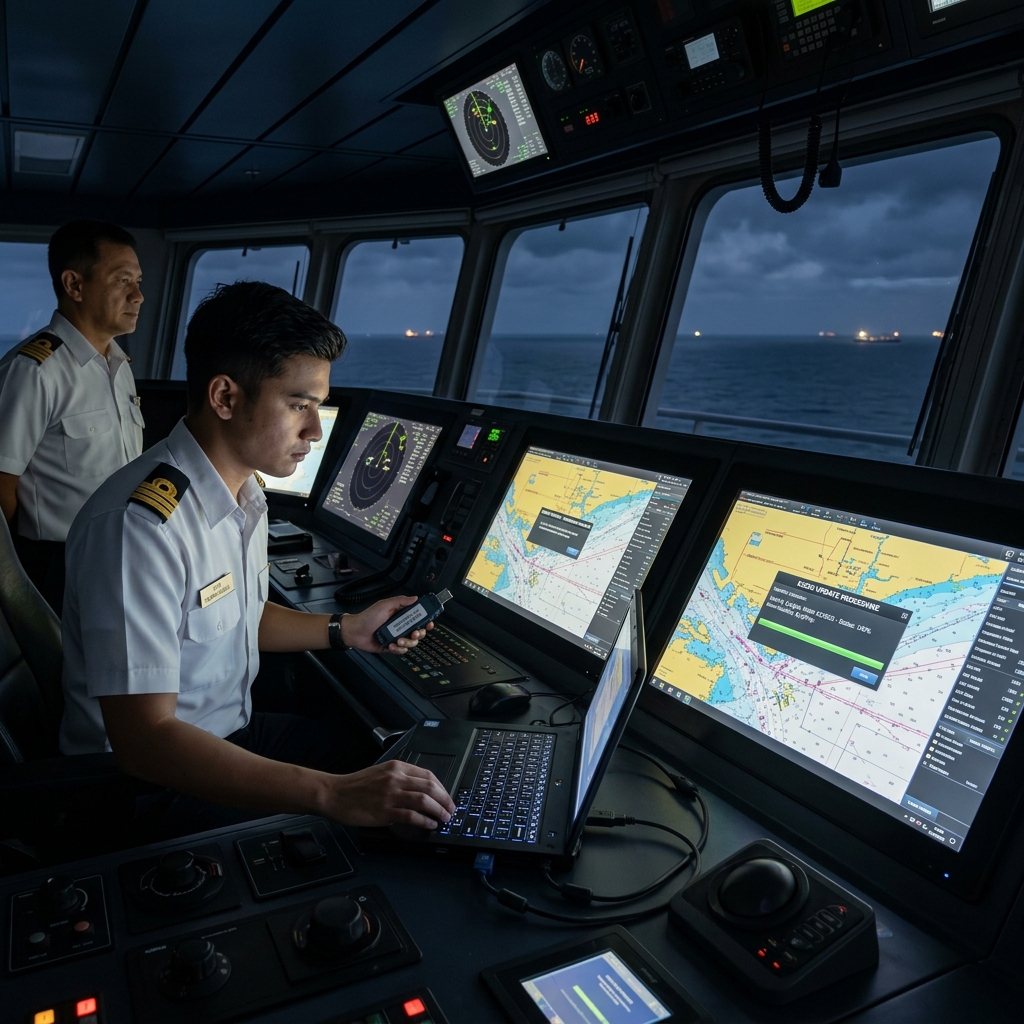
Navigational Charts update procedures

The navigation chart on a bridge is only useful if it reflects the current state of the world. Wrecks shift, buoyage changes, depth surveys revise, navigational warnings come and go. The discipline of keeping charts current - paper or electronic - is a regulated requirement and a practical safety necessity. For vessels supplied at Chennai Port, chart updates are a routine part of the bridge stores supply, and the procedures around them are worth getting right.

Paper charts and the weekly Notice to Mariners

Paper charts published by national hydrographic offices (UKHO, US NOAA, Indian Naval Hydrographic Office for regional waters) are corrected through weekly Notices to Mariners. The notices specify chart numbers and the corrections to be applied - new lights, removed wrecks, updated soundings, changed buoyage, navigational warnings.

The corrections are made by hand, in the prescribed colour ink, against the published Notice. Each correction is initialled and dated by the navigating officer. The Notice itself is filed in the chart correction log alongside the certificate of correction. A chart with corrections that lag the published Notices is not properly maintained, and a port state inspector reviewing the chart correction log will spot this immediately.

For a vessel maintaining a folio of 200+ paper charts, the weekly correction discipline is significant work. It is also non-negotiable.

ENCs and the digital correction stream

Electronic Navigational Charts (ENCs) updated through ECDIS systems use a similar correction logic but apply through digital files rather than manual annotation. The ECDIS pulls weekly corrections from the chart provider's distribution channel and applies them to the loaded charts. The system logs the correction state and produces an audit-ready record of which corrections have been applied to which charts.

The ECDIS correction process is technically more reliable than paper because it cannot be skipped through inattention - the system flags overdue corrections. The discipline shifts from doing the corrections (automatic) to ensuring the chart subscription is current and the system is downloading correctly.

New chart supply and folio updates

When a vessel changes trade and starts calling new regions, new paper charts and ENC permits need to be acquired for the new waters. Paper charts are ordered through chart agents who source from the publishing hydrographic office. ENC permits are purchased per chart through the chart distributor and loaded onto the ECDIS.

For vessels at Chennai, chart agents work alongside chandlers to supply both paper charts and ENC permits as part of bridge stores. Lead time on standard paper charts is days; less common charts can take weeks.

Publications alongside charts

Chart updates are part of a broader publications maintenance regime. Sailing directions, lights lists, radio signals, tide tables - each is published by the relevant hydrographic office and updated periodically. New editions supersede old ones. The vessel's publications inventory should be reviewed annually to identify superseded editions and order replacements.

This is a category where vessels often have lapsed editions sitting on the bridge. The cost of replacement is small; the consequences of operating with outdated information are not.

Navigational warnings and route-specific updates

Beyond the weekly Notices, navigational warnings cover specific local hazards - wreck removals in progress, naval exercises, hydrographic survey work, pipeline laying. These are time-limited but operationally significant. The warnings are received via NAVTEX, SafetyNET, and other GMDSS channels, and the navigator should consult them when route planning rather than relying on the chart alone.

Inspection-readiness

Port state and flag state inspectors routinely check chart and publication currency. The chart correction log, the ECDIS update record, the ENC permit list, and the publications inventory should all be presentable on demand. A vessel where this material is in good order communicates a level of operational discipline that influences the rest of the inspection. A vessel where it is not raises questions about the rest of the bridge management as well.

The chandler's supply role

From a Chennai chandler's perspective, chart and publication supply is part of the bridge stores category - regular but demanding precision in matching specific chart numbers, edition dates, and ENC permit zones. Mistakes here are difficult to recover from once the vessel has sailed. Pre-confirming the supply against the vessel's request is more important here than in most other categories.

Charts and publications are an old discipline, slowly modernising through the digital transition. The discipline of keeping them current has not changed.

For navigational chart, ENC permit, and publications supply at Chennai Port, see our ship chandler at Chennai Port bridge stores scope.

← Back to News