Lifesaving Equipment Maintenance

Lifesaving equipment is the part of the vessel's inventory that should be the most boring - because if it ever needs to perform, the day has gone very badly already. The maintenance discipline behind it is correspondingly unglamorous: scheduled service intervals, third-party inspections, correct stowage, regular drills. The discipline either exists across the year or it does not, and the gap shows up at port state control inspection or, worse, in an actual emergency.

For vessels supplied through Chennai Port, lifesaving equipment maintenance often happens at port - service teams come on board to inspect, replace, and certify. Here is what the structure looks like, category by category.

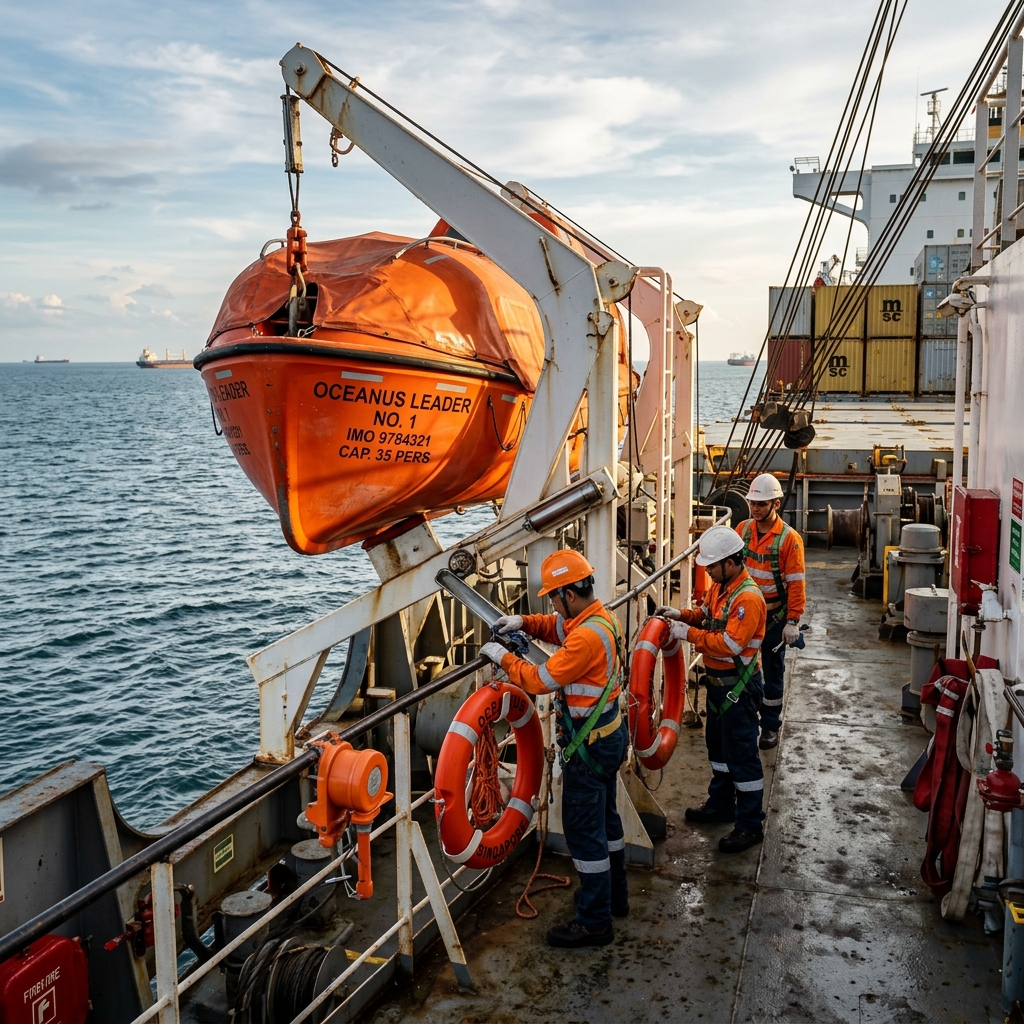
Lifeboats and rescue boats

Annual thorough examination by approved service personnel. Five-yearly load test of release gear and falls. Periodic running of the engine to confirm starting and propulsion. Davit and winch inspection at the same intervals. The records are signed off in the vessel's continuous synopsis records and are the first documents an inspector asks for.

Lifeboat hooks - the on-load release gear - have specific service requirements following the IMO regulations introduced after multiple incidents in the early 2010s. The hook service is not a generalist task; it requires manufacturer-trained personnel and approved replacement parts. A vessel that has lapsed on lifeboat hook service has a substantive deficiency, not a paperwork oversight.

Liferafts

Liferafts require annual servicing at an approved liferaft service station. The station opens the raft, inspects every component (canopy, inflation system, rations, equipment), replaces consumables that have reached expiry, repacks, reseals, and provides a service certificate. The service is not done on board.

For vessels at Chennai Port, the typical workflow is for the chandler to coordinate the liferaft swap - supplying a serviced replacement raft to the vessel and taking the on-board raft to the service station. This minimises vessel downtime. The replacement raft must be of identical type and capacity, with current service date.

Personal lifesaving appliances

Lifejackets, immersion suits, and lifebuoys all have inspection regimes - typically annual visual and operational checks supplemented by random unit-level destructive testing across the fleet. Lifejacket lights have battery expiry dates that need tracking. Immersion suits have material integrity tests. Lifebuoy self-igniting lights and self-activating smoke signals have specific service intervals.

The aggregate effect: a vessel of 25 crew might carry 40-50 lifejackets, 15-20 lifebuoys, and 30+ immersion suits across all the locations they need to be stowed. Tracking the service date of each item without a structured record-keeping system is functionally impossible. The standard is a maintained register, item-by-item, accessible during inspection.

Pyrotechnics

Distress flares, smoke signals, and rocket parachute flares have manufacturer-specified expiry dates - typically 3-5 years. Expired pyrotechnics are not just a deficiency but a hazard; old flares can fail to fire or fire unpredictably. Replacement is straightforward but requires advance planning because expired pyrotechnics cannot be casually disposed of - they need return through approved channels.

A common Chennai workflow is for the chandler to supply replacement pyrotechnics and take back the expired ones for proper disposal at an approved facility. This is a service the vessel should expect rather than handle independently.

EPIRB and SART

The Emergency Position-Indicating Radio Beacon (EPIRB) and Search and Rescue Transponder (SART) have battery and hydrostatic-release service intervals that need to be tracked precisely. Some EPIRB batteries have a 5-year service life; the hydrostatic release units typically 2 years. Missing either renders the equipment ineffective in an emergency. Both devices also need annual operational testing as part of the GMDSS routine.

Documentation that survives audit

Across all categories, the principle is the same: every service event is recorded, the certificates are filed, the next due date is calendared, and the responsible officer signs off. A vessel where the records can be produced cleanly within minutes of an inspector's request is a vessel where the underlying discipline is intact. A vessel where the records have to be reconstructed from memory has a problem regardless of what is in the actual lockers.

Lifesaving equipment maintenance is not optional and is rarely glamorous. It is one of the operational areas where chandlers, service stations, and ship's officers work most closely together - because a failure on any side becomes a failure for the whole vessel.

For lifesaving equipment supply, service coordination, and replacement at Chennai Port, see our ship chandler at Chennai Port safety scope.

← Back to News