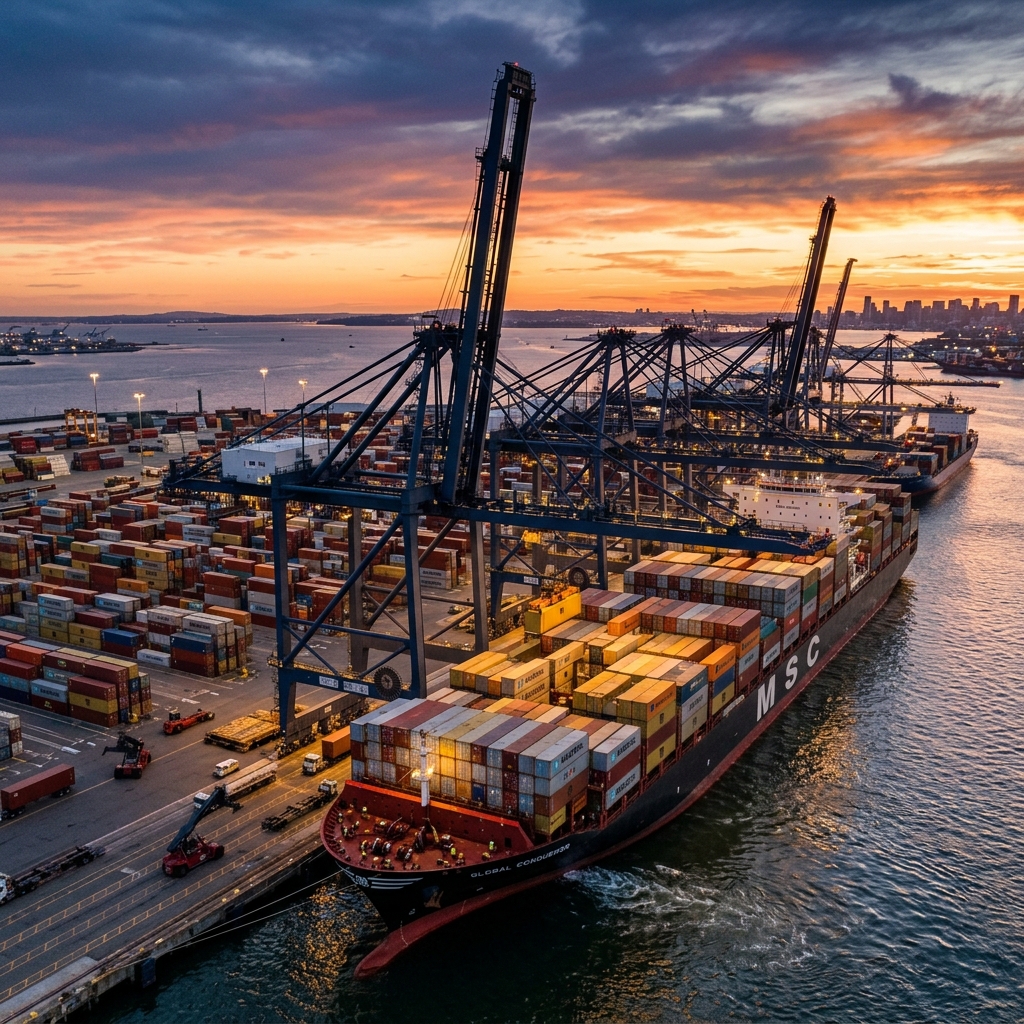
Freight forwarding for marine supply has always been a bridge function - moving goods from a manufacturing source to a vessel at a port, often across multiple borders. The fundamentals are old. What has changed in the last few years is the variability: lead times that swing wildly between calm periods and disrupted ones, customs regimes that change with little notice, capacity that tightens unexpectedly on specific lanes. None of this is unique to marine supply, but its impact on vessel operations is direct.
For supplies destined for vessels at Chennai Port, freight forwarding routinely involves Asian, European, or American origins, and the challenges show up at predictable points along the route. Here is the practical map.
Capacity volatility on key lanes
Air freight capacity into India - particularly into Chennai - varies significantly by season and by global event. A capacity tightening in one part of the world can ripple through to Indian inbound capacity within days. For routine planned shipments this is manageable; for urgent spares the capacity gap can mean accepting longer lead times or paying premium rates that were not part of the original budget.
The hedge is multi-source planning: identifying alternate origins for critical items so that capacity issues on one route do not block the supply entirely. Forwarders with broad multi-lane capability handle this naturally; single-route specialists struggle when their lane tightens.
Customs regime changes
Indian customs has tightened documentation requirements progressively over the last decade, integrating digital customs systems with progressively more verification. For marine supplies, the implications include more detailed HS code classification, more aggressive valuation challenges on under-invoiced goods, and tighter scrutiny of certificates of origin. Vessel-bound goods enjoy specific exemption regimes when properly documented but lose those exemptions when documentation is incomplete.
For forwarders, this means the customs broker function has become more substantive than it once was. A broker who treats classification as a clerical task rather than an analytical one will produce delays at port; a broker who pre-validates documentation against current customs interpretations clears shipments faster.
Origin documentation and compliance
Free trade agreement preferences require certificates of origin that meet specific issuing-authority criteria. For Indian-bound shipments under various trade preferences, the documentation has to match the preferential origin rules exactly - country of substantial transformation, value-added thresholds, supporting manufacturing evidence. Vessel-supply shipments often miss out on preferential rates simply because the documentation discipline at origin is weak.
This is unglamorous money: getting the documentation right at origin shaves cost from every routine shipment. Forwarders who pay attention to this earn their margin many times over.
Last-mile coordination at the destination port
Goods landed at Chennai air cargo or sea cargo terminals still need to clear customs, transfer to bonded warehouse if applicable, and ultimately move to the vessel. Each handoff is a potential delay point. Forwarders who own or partner closely with the local handler can compress these handoffs; arms-length forwarders dependent on multiple intermediaries cannot.
For urgent vessel supplies, the difference between a 4-hour clearance-to-vessel time and a 24-hour clearance-to-vessel time is precisely this coordination capability.
Currency and price stability
Long-lead supply contracts increasingly run into currency volatility. A spare ordered three months ahead and invoiced on delivery may be subject to currency movement that erodes the original commercial terms. Forwarders who can offer fixed-rate terms or hedged pricing on extended contracts add value beyond the freight component itself.
The geopolitical layer
Routing decisions increasingly factor geopolitical risk - regional conflicts that affect shipping lanes, sanctions regimes that affect specific products or origins, port labour conditions that affect throughput. None of this is the forwarder's choice to make, but the forwarder is the entity that has to operationally route around it. Forwarders with active risk monitoring and route flexibility outperform those treating shipping lanes as fixed infrastructure.
Visibility for the vessel agent
The single biggest operational improvement the forwarder can offer the vessel agent is visibility - real-time status of the shipment from origin pickup to vessel handover, alerts on delays, and proactive replanning when problems arise. The technology to do this is widely available. The discipline of using it consistently is what differentiates serious forwarders from claim-based ones.
Marine freight forwarding is not glamorous. It is operationally consequential. The forwarders who handle the boring work consistently - documentation accuracy, multi-lane capability, customs depth, last-mile coordination - are the ones whose vessels rarely miss sailings because of supply.
For freight forwarding coordination, customs clearance, and onward delivery to vessels at Chennai Port, see our ship chandler at Chennai Port logistics scope.