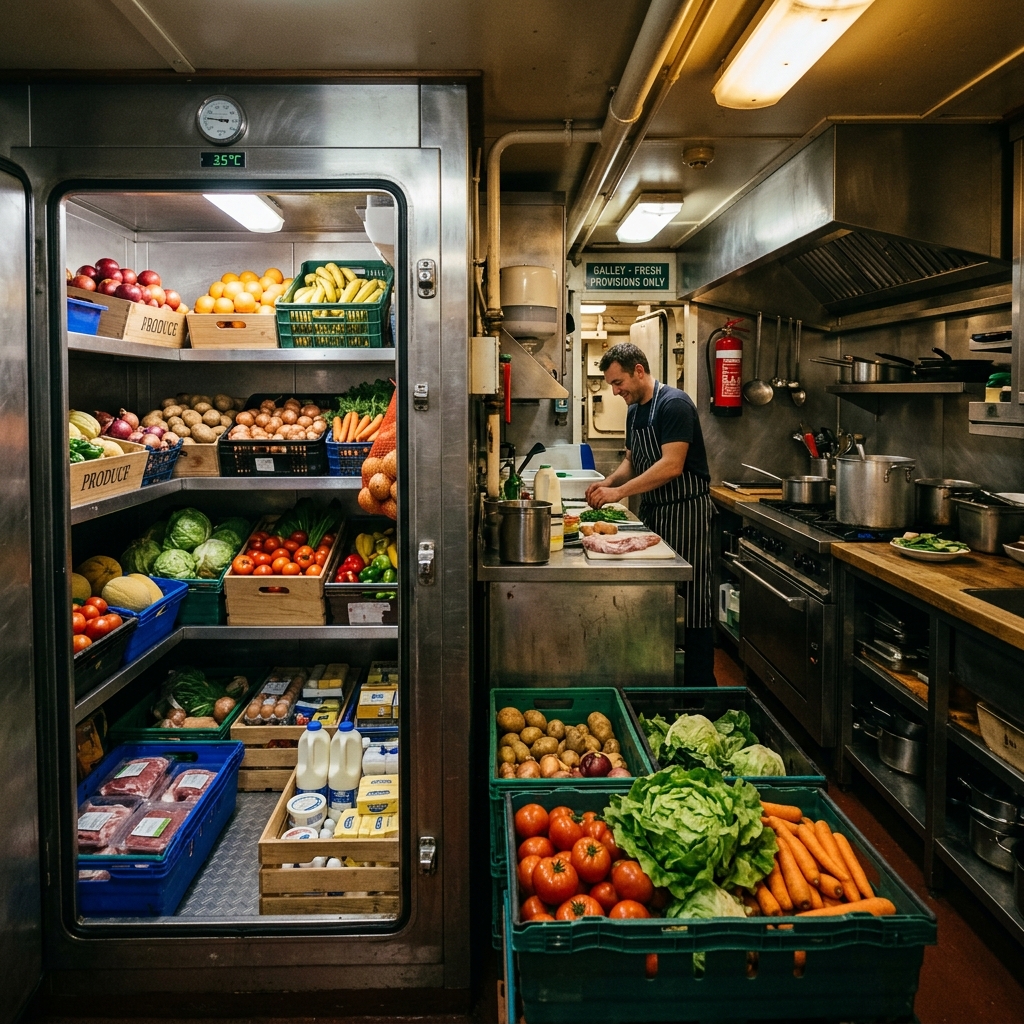
A frozen box of mackerel has two temperatures that matter. The first is the core temperature at which it was blast-frozen at the supplier - typically -25 to -30 degrees Celsius. The second is the highest temperature it has reached at any point between that freeze and the vessel's freezer room. A warehouse accident at -15 degrees for even a couple of hours changes the product's storage life and, in the worst case, its microbial safety. The freezer reading on board the vessel tells you nothing about what happened in transit.
Cold chain integrity is the part of ship provision supply that is easiest to get wrong and hardest to recover from. For vessels taking long voyages after departing Chennai Port, the provisions loaded today will sit in the ship's freezer for three to six weeks. Any temperature excursion at the loading stage compounds through that period.
Three break-points we watch constantly
The first is receiving. When a supplier truck arrives at our warehouse, the core temperature of the load is checked with a calibrated probe at the front, middle, and rear of the trailer. If any point reads above threshold, the load is refused - not negotiated. A small supplier may push back on the refusal; we do not move on this. A frozen product that arrives warm will not recover properly, no matter what the outer packaging says.
The second is warehouse handling. Loading doors open and close dozens of times a day. Even a well-insulated freezer room drifts upward by a few degrees when the door is open. Staff training here is mundane but critical: minimise door time, stage the outgoing pallet before the door opens, close the door between transfers.
The third is transit. Our delivery vehicles are reefer-equipped and run with independent temperature loggers that run for the full journey. The logger is not accessible to the driver; it is a sealed unit that generates a time-stamped log the vessel receives at handover. If the log shows an excursion, the delivery is flagged and the affected items are pulled.
Chennai heat is a real variable
Between April and October, ambient temperatures at Chennai Port regularly exceed 35 degrees Celsius, and dockside surfaces can read considerably higher. A pallet that sits on the quay for 30 minutes before being craned on board is losing cold-chain margin fast. We plan deliveries so that frozen and chilled items spend as little time in the open as possible - ideally moving straight from reefer vehicle to the vessel's freezer room with a single hoist step in between.
This is a planning exercise more than a technology exercise. It means coordinating with the deck officer on crane availability, not just sending the truck and hoping.
The paperwork that makes cold chain auditable
Increasingly, shipping lines require a documented temperature trail from source to delivery. This is not busy-work - it is the evidence that lets the vessel's master accept the provisions without uncertainty, and it is the evidence that will answer any port-state or flag-state question weeks later. Our standard paperwork for frozen and chilled deliveries includes supplier certificate, receiving log, warehouse storage log, transit log, and handover signature.
When it goes wrong
Despite all of this, things occasionally go wrong. A reefer unit fails in transit. A supplier delivers a marginal load. A warehouse freezer trips overnight. What matters then is how quickly the excursion is detected and how the response works. Our standing rule: flag immediately, quarantine the affected stock, source replacement from a pre-approved backup supplier, and document the full sequence for the shipping line. No silent substitution, no quiet re-labelling. The shipping line owns the decision.
Cold chain is one of the less visible parts of what a chandler does. It is also one of the areas where the difference between a disciplined operator and a casual one shows up first.
For cold-chain disciplined provisions supply at Chennai, Ennore, and Kattupalli, see our ship chandler at Chennai Port service overview.