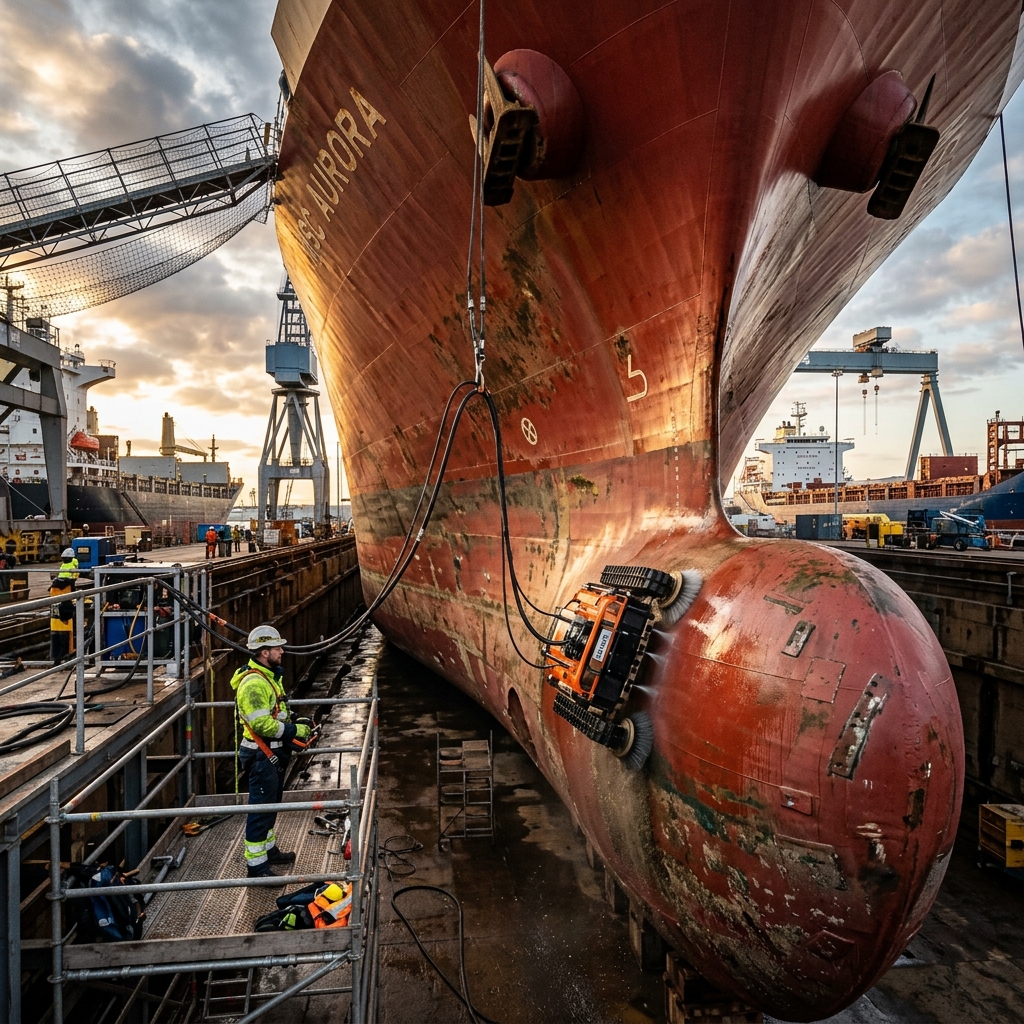
Advances in Hull Cleaning Technology

Hull biofouling - the accumulation of marine organisms on a vessel's underwater surfaces - is more consequential than it sounds. A heavily fouled hull can increase fuel consumption by 10-20% across a voyage, and that translates directly to operating cost and emissions. The conventional response was to wait for dry-docking and clean at the next yard visit; the modern response is in-water cleaning at frequent enough intervals to prevent significant accumulation in the first place. The technology behind in-water cleaning has evolved noticeably in the last decade.

For vessels calling at Chennai Port and Ennore, in-water hull cleaning is increasingly part of routine operational maintenance rather than an occasional emergency measure. Here is the practical landscape.

From manual scrubbing to remote systems

Traditional underwater hull cleaning was diver-based: certified commercial divers using rotary brushes or scrapers to remove fouling manually. This still happens for spot work and where specific control is needed, but the bulk of routine cleaning has moved toward remote-operated systems.

Remote brush trolleys (sometimes called HullSkaters) operate as crawling units that traverse the hull with rotating brushes, controlled from the surface. They cover large areas faster than divers, do not put humans in the underwater work environment, and can be deployed at ports where diver permits are difficult. The cleaning is typically less aggressive than diver-applied work, which means more frequent intervention but less coating wear per cycle.

Capture systems and discharge controls

The growing concern with hull cleaning is not the cleaning itself but what gets released into the port water during the cleaning. Antifouling coatings shed biocidal material as they wear; cleaning that mechanically removes coating accelerates this release. Modern in-water cleaning systems increasingly include capture mechanisms - filters and collection systems integrated into the cleaning head that capture both the biofouling debris and the released coating particles for shore disposal.

This matters for port acceptance. Some ports now restrict in-water cleaning to capture-equipped operators only. Chennai Port and Ennore have not yet adopted the strictest version of this rule but are following industry guidance, and the practical expectation is that capture systems will become standard within a few years.

Coating compatibility

Different antifouling coatings tolerate different cleaning regimens. Self-polishing coatings are designed to maintain antifouling performance through a planned wear cycle and respond well to gentle, frequent cleaning. Hard-coating systems require less cleaning but are more sensitive to mechanical wear. Foul-release coatings (silicone-based) require very gentle cleaning - aggressive scrubbing damages the coating and reduces its working life.

The vessel's coating specification determines the right cleaning approach. Mismatched cleaning - aggressive cleaning of a foul-release coating, for instance - causes more damage than the fouling it removes.

Inspection and condition assessment

Before cleaning, an inspection survey establishes the fouling level, the coating condition, and any underlying hull damage. Modern inspection often uses ROV camera systems that produce a complete underwater photographic record. This serves multiple purposes: it confirms the cleaning need, it documents the pre-cleaning condition for any later coating warranty discussions, and it identifies hull damage that needs separate attention.

Post-cleaning inspection confirms the cleaning was effective and documents any coating damage caused. Both records are part of the vessel's hull maintenance history.

The fuel efficiency case

The economic case for in-water cleaning is straightforward. A 10% fuel saving on a vessel burning 30 tonnes per day at sea is roughly 3 tonnes per day or about USD 1,500-2,000 per day at current bunker prices. Across a 30-day operating cycle that is USD 45,000-60,000. Cleaning cost - even with the most expensive system - rarely approaches a third of this. The payback is fast and the carbon emission reduction is real.

Coordinating in-water cleaning at Chennai Port

In-water cleaning at Chennai requires port authority coordination, specifically because of the discharge implications. The chandler typically coordinates the service through certified providers, manages the port permission paperwork, and aligns the cleaning window with the vessel's berthing schedule. For vessels in extended port stays, the cleaning fits into the available time without delaying departure.

Hull cleaning was once a yard activity. It is now an in-water service that can be planned, captured, documented, and integrated into the vessel's normal port routine - which is where it should be.

For underwater hull cleaning coordination at Chennai Port, see our ship chandler at Chennai Port additional services scope.

← Back to News